
Writing for the Society’s 1929 Transactions, and drawing on the memories of his grandfather and local traditions, Stanley Kent tells the story of a town that had seen only gradual change before the coming of the railways
From my early youth I have taken great interest in St. Albans as it was a hundred or so years ago, this interest having been aroused in me by my grandfather, Thomas Weedon Kent. Born at St. Albans in 1806, he lived in the town until his death in 1900 at the age of 94. The possessor of a very retentive memory, he was always ready to tell me his recollections of the place, complete with names and dates.
As time went on I collected a number of old prints and photographed many buildings that have now disappeared, so that I have at command material with which I will endeavour to draw a picture of St. Albans as it was when my grandfather was a boy. A study of old maps of St. Albans will show us that the growth of the town, prior to the middle of the nineteenth century, was so slow as to be almost imperceptible, and it was not until the coming of the railway in 1858 that the town began to branch out. [1]
Not much more than a village …
From a map of 1810, drawn by G. Cole and embellished with a charming little picture of the Abbey, we learn that St. Albans was then a mere skeleton of what it now is. It consisted of St. Peter’s Street, the Market Place, Chequer Street, High Street, Holywell Hill, Sopwell Lane, George Street, Fishpool Street and St. Michael’s Street, with just a few byways branching off from these. At that time there were not many more than 300 houses, with some 3,000 inhabitants, but what the town lacked in size and population was amply compensated for by its beautiful situation and picturesque appearance.
… but a busy coaching halt
Being the first important stopping-place out of London on the north-west road, St. Albans, in the early days of the nineteenth century and well into the thirties, was full of inns and posthouses, for some seventy coaches daily passed through the town. The hostelries did not depend only upon travellers, for the tavern or inn filled a large place in the lives of our forefathers, who, it must be remembered, had no clubs, institutes for working men, picture palaces, or other places of amusement. When the day’s work was done, the lawyer, the schoolmaster, the butcher, the baker, all in fact of every class, repaired to the tavern, the smoking room being regarded in the light of a club.
These inns, most of which have now been converted into dwelling-houses or shops, were then centres of bustle and activity. Smartly painted coaches rumbled up to their doors three or four times a day, when fresh horses would be led out from the capacious stables, the guard would rummage in his box for letters and parcels, the driver would climb down from his seat to stretch his legs and wash the dust of the road from his throat with a tankard of good old ale, and the passengers would follow his example. But they would need to hurry or, before they had been served and the drink had reached their lips, the guard would blow his horn, shout “Time’s up !” and off they would have to go. Here, too, at all hours came the postchaises, their occupants wanting horses or food, or possibly accommodation for the night.
The risks inseparable from coaching added a zest to travel. In winter the passengers might find themselves marooned in a snowdrift, as happened to the Liverpool mail in 1836 when it stuck fast in twenty feet of snow near the spot where the railway bridge now spans the London road, and where the turnpike then stood at the junction of the old and new London roads.2 At about the same time and near the same spot a race between the Holyhead mail and the Chester mail had a disastrous sequel. The former, in attempting to pass the latter, caused a bad smash in which one passenger was killed and several seriously injured.
The railways spell the end for long distance coaches
With the advent of the railways all this was changed. One by one the coaches disappeared, one by one the postchaises were relegated to the scrap-heap. Then it was that most of the old inns of which I shall speak later began to disappear, though we still have the old gateways of several to show where they once stood. As St. Albans received its chief support from travellers, the end of the coaching age was a tragedy, not only to the coachmen and postboys, but to the innkeepers, harnessmakers, farriers, and a great number of its inhabitants whose careers and livelihood were bound up in the old order of things.
All the fun of the ‘Statty’ fair
There were three fairs held annually in the town, one on Lady Day, another on St. Alban’s Day for horses and cattle, and the third and most important at Michaelmas. This last was the Statute Fair, where the farmers hired their men and maidservants for the ensuing year from among those who stood in the open market-place waiting to be engaged. St. Albans must have been an ideal place for a Fair, with its spacious St. Peter’s Street for the display of cattle and goods, and its many inns for the convenience and refreshment of both dealer and purchaser. One can imagine how, at a time when there were but few opportunities for recreation, an event like the ” Statty ” appealed to the people. [Editor’s Note: in recent years, Statty fairs have continued in nearby Harpenden].
The lads and lasses, just free from a year’s hiring and ready to enter upon a fresh engagement, flocked into the town from the surrounding villages and revelled in ” the fun of the fair.” They found the principal streets filled from end to end by stalls laden with gingerbread, stewed pears and other delicacies, besides an infinite variety of goods calculated to loosen the purse-strings of young and old.
Here, too, were exhibitions and shows, with gaily painted exteriors and spangled dancers on the front platforms, giving no small delight to the care-free and uncritical countryfolk. Among these entertainments was Richardson’s Theatre, always the chief attraction of the St. Albans ” Statty,” and one of the chief at the famous Bartholomew Fair in London.[3] This entertainment included, in the course of fifteen minutes or so, a melodrama with a ghost and several murders, a comic song by way of interlude, and a pantomime. We may be sure that the varied excitements of the Statute Fair furnished the neighbourhood with topics of conversation for many a day afterwards.
As winter drew on the town must have been dismal enough at night, being lighted by small oil lamps scattered at long intervals and liable to be blown out by a high wind.[4] Coal was scarce and expensive, having to be carted from the Grand Junction Canal at Boxmoor. A watchman would parade the streets, equipped with staff, rattle and lantern, his chief duty being to disturb the silence of the night by crying the hour: “Past twelve o’clock, and a cold frosty morning,” though he was also enjoined to use his ” utmost endeavour ” to prevent any robbery in the town. As the watchman was generally advanced in years it seems probable that his utmost endeavour did not amount to much.
A journey through the old town
I will now ask you to accompany me in an imaginary walk through the old streets of St. Albans, when we will try to gain some idea of the town as it was a hundred years ago, and of some of its inhabitants at that period. We will start our ramble at one of the oldest entrances to the town, Sopwell Lane. The south-east end of this street, still called Park Corner, was formerly well wooded, and an avenue of trees led into the grounds of Holywell House, of which I shall have more to say later. A century ago the Goat Inn was a favourite house of call for the St. Albans tradesmen, and here the latest news would be discussed over long pipes and foaming tankards.
On reaching Holywell Hill we notice Russell House School, where formerly stood the Crown Inn, kept by a man named Ward and largely patronised by sporting men, especially in the winter when hunting was the only recreation the neighbourhood afforded.
Sarah Spencer’s Holywell House
Near the bottom of the hill, where No. 76 now stands, were ornamental gates with lodges on either side of a drive leading up to Holywell House.[5] The road then ran at the back of the present row of cottages and through the river, over which was a wooden bridge for pedestrians. Having passed through the gates and proceeded along a circular drive, one reached the front of Holywell House, the spacious mansion of the Spencer family, where once resided the famous Sarah, Duchess of Marlborough.

Holywell House, shown on a map devised by SAHAAS volunteers (© SAHAAS)
The garden front opened to the lawn by a kind of cloister, being part of an earlier building which stood on this spot. The garden, which was beautifully laid out with terraces, ornamental water and flowering shrubs, covered what are now the grounds of Ver House and the St. Albans School playing field, and extended to Sopwell Lane. The Holy Well from which the estate derived its name stood on the lawn in front of the house, and was the celebrated well the water of which was said, in ancient days, to have worked miraculous cures. It is now covered in, with only a stone slab to mark the site.
In 1836 Mr. Reid, who was then the owner of Holywell House, died, and the property came into the market. This gave the long-desired opportunity to do away with what must have been a dangerous corner for coaches, so a new road in a direct line with the rest of Holywell Hill was cut through the estate, necessitating the demolition of the house.
As we have far to go we must content ourselves with a distant view of St. Stephen’s Church which, before its restoration in 1861, had a squat wooden tower capped with a tiny spire. In 1840 a proposal to pull down the whole building and use the materials to make a new church at Frogmore was actually agreed to at a vestry meeting, but happily the resolution was cancelled shortly afterwards.
We will now wend our way up Holywell Hill where, a century ago, we should have seen the White Hart, Saracen’s Head, Dolphin, Woolpack and Peahen, of which only the first and last remain to-day, though we still have the old gateways to show where the others stood. The White Hart was the chief posting inn in the town and, to judge from a drawing in the Pridmore Collection, has not changed much in appearance during more than a hundred vears.

The White Hart Hotel, an old coaching inn on Holywell Hill (Peter Bourton)
Tragic accident
The lowness of the gateway was once the cause of a fatal accident. The guards of the coaches were accustomed to shout “Heads ! Mind your heads ! ” as their vehicle entered the gateway, but a lady passenger did not hear or did not heed the warning, and her neck was broken in consequence. The entrance to the Saracen’s Head still remains, and a little higher up the hill was the Dolphin, while No. 5 was formerly the Seven Stars. On the opposite side of the road is the Postboy, and here until recent times stood the Trumpet, both names recalling coaching days.
Immediately below the Peahen stood the Woolpack, originally a much more important inn than its neighbour. Not only did it run a coach of its own, ” The Accommodation,” to and from the Ram Inn, Smithfield, but it also did a good posting business. [6] About 1852 the Woolpack came into the market and was purchased by Mr. Marks, then the landlord of the Peahen, who converted the two houses into one. Proceeding up Chequer Street we come to the site of the Red House, an inn that formerly blocked the street, facing down the hill, leaving barely sufficient space for a waggon to pass between it and what is now Elliott’s shop, a narrow alley on the other side of the inn being used by pedestrians. This house proved such a terrible obstruction that it was pulled down about 1832.
Stage waggons
On the site of the present Queen’s Hotel formerly stood a little inn called the Chequers, from which Chequer Street derived its name. From this inn a stage waggon used to start every Monday and Thursday at two o’clock in the morning for the Three Cups in Aldersgate Street, returning at six o’clock the same evening. Stage or carrier waggons were intended in the first instance for the conveyance of heavy goods, but found room for those travellers who could not afford the expense of hiring horses or coaching. The Town Waggon, as it was called, could not, however, have been overburdened with passengers, as my grandfather told me that the poorer people in St. Albans never thought of travelling.
In 1820 Thomas Coleman, a celebrated trainer, came to St. Albans and, having taken the Chequers, persuaded the brewer who owned it to rebuild and rename the house. As the Turf Hotel this inn was for the next twenty-five years the headquarters of all kinds of sport on the northern side of London. It was fitted with hot baths (a rare luxury in those days), and had a good chef and a choice cellar. Here many well known dandies kept their racehorses in the commodious stabling which extended down to where Marlborough Road now is.
Fight to the death
From here Tommy Coleman collected £30, each St. Albans magistrate subscribing £1, to get up the notorious fight between Deaf Burke and the Irish champion, Simon Byrne. The fight, which took place on Nomansland on May 30th, 1833, was most strenuous and lasted three hours. At the end of fifty rounds Byrne, who had killed a man in his previous conflict, had received such severe injuries that he died. He was buried just outside the west end of the Abbey.
Steeplechase
In 1829 Coleman held a race meeting on Nomansland, near St. Albans, in which George IV ran a horse and won the Gorhambury Stakes. This meeting was not a financial success so, the following year, Coleman induced Lord Verulam to consent to the venue being changed to Gorhambury Park. The experiment proved so successful that from 1830 until Lord Verulam’s death in 1845, the races were regularly held for two days each year, between the Epsom and Ascot meetings, and were patronised by all the leading celebrities of the turf. Lord Verulam owned many good horses, and “Gorhambury,” bred by his lordship, ran second for the Derby in 1843.
At the Turf Hotel, in 1830, originated the first regular steeplechase run in England, and for eight or nine years the event became an important fixture in the sporting calendar. Each year the races were run over a different course, but mostly near St. Albans. The steeplechase of 1836 started from Harpendenbury and finished near St. Michael’s Church, being won by Mr. Elmore’s horse Grimaldi, which fell dead at the winning-post.
Similar meetings sprang up all over the country, and Coleman’s richer rivals gave ” added money,” whereas he himself could not afford to add a shilling to the stakes, and so the sporting old innkeeper found himself cut out, and in 1839 the St. Albans steeplechases came to an end. A sketch made bv Buckingham in 1853 shows the Turf Hotel tap (now Dr. Puddicombe’s residence) to be the only house in Marlborough Road at that time. Branching- off from St. Peter’s Street, which is described in an old guide book as “the most genteel” part of the town, is the former Sweetbriar Lane (now Victoria Street), [7] a favourite resort for courting couples when Mr. Dorant’s house was the Grange Farm.
Water for cattle and people
In those days St. Peter’s Street had two ponds for the refreshment of cattle coming in to the market, one near the White Horse and the other in front of the Cock. The War Memorial garden was then an open green known as St. Peter’s Green, while the memorial itself occupies the spot where a pump formerly stood. Messrs. Rumball and Edwards’ offices were then the St. Peter’s parish workhouse, the paupers it sheltered being employed in the care and repair of the roads. At the back was a building, well fenced in to prevent escape, in which the poor worked at their tasks.
The tower of St. Peter’s Church is not very old, having been built between 1803 and 1806 to replace the old tower, of which a considerable portion fell in 1801, leaving the remainder in so ruinous a condition that the whole of it had to be demolished. Immediately to the north of the church stood Hall Place, now rebuilt but still possessing the original handsome wrought iron gateway.
No. 107 St. Peter’s Street was formerly occupied by a Miss Cotton, whose charitable nature led her to find employment for poor people in the winter by paying them to dig a huge hole in her garden, and paying them in the following winter to fill it up again.
It will not take us long to see Cock Lane, as the top part of Hatfield Road was then called, for, passing a row of six almshouses and the Marlborough Buildings on our right, we come to the Peacock Inn, between which and Hatfield there were probably not more than half a dozen houses, with the exception of the Horseshoe Village. We have now seen practically all the north end of the town, though there was a row of cottages at the back of the Cricketers called Snatchup End, so we will retrace our steps to where the Town Hall now stands.
On that site formerly stood three almshouses for poor widows, while in front of them was the old Blue Pump, which was seldom in repair and so was not greatly missed when it was removed in 1829. The Mansion, now No. 1 St. Peter’s Street, the fine Georgian house that has been so sadly disfigured, had then a garden at the side with a wall and gateway, all of which disappeared when Spencer Street was constructed. In the upper storey of the old Town Hall, at the corner of Dagnall Street, were held the Quarter Sessions for the Borough and Liberty of St. Albans, as were also the meetings of the Corporation. The lower part was used as the Borough Gaol, or Counter as it was called, the prisoners in which were visible from Dagnall Street as they stood behind the bars of the lock-up. In front of this old hall my grandfather saw a man placed in the pillory and pelted with eggs and all kinds of rubbish, and he told me it was a terrible sight.

St Albans Town Hall (SAHAAS collection)
The present Town Hall was built in 1829-30, and about that time a number of other changes took place in St. Albans. For example, the three almshouses, the Blue Pump, the Red House, were swept away, and the ponds in St. Peter’s Street were filled in. On the site of the Corn Exchange stood the Market House, a barn-like building with a double roof supported by eighteen plain square wooden posts. On Saturday market-days there was a good trade done in all kinds of grain, especially wheat and barley. As the farmers were obliged to sell their corn in bulk they probably left their load at a neighbouring inn and dumped a sample sack here.
Jolly japes
An amusing incident is related concerning the old Market House. One Friday evening a party of apprentices noticed a large loaded waggon standing in front of the building, and thought it would be a joke to put it inside. Setting two of their number to keep a look-out for the watchman, they quickly unloaded the waggon, removed the wheels and, tipping it up sideways, carried it bodily between the posts and then reassembled it inside and loaded it up once more. The next morning, being market-day, there was great excitement among the wondering townsfolk, who could not imagine how this cumbersome waggon, too wide to go between the posts, had got in. They examined all the posts and found that none of them had been disturbed, while the roof was intact.
In those days anything that could not be explained was attributed to witchcraft, and it was decided that his Satanic Majesty was responsible for the mysterious occurrence. It was not until they had started to remove one of the posts that someone in the know told them how the cart could be got out.[8]
The Clock House
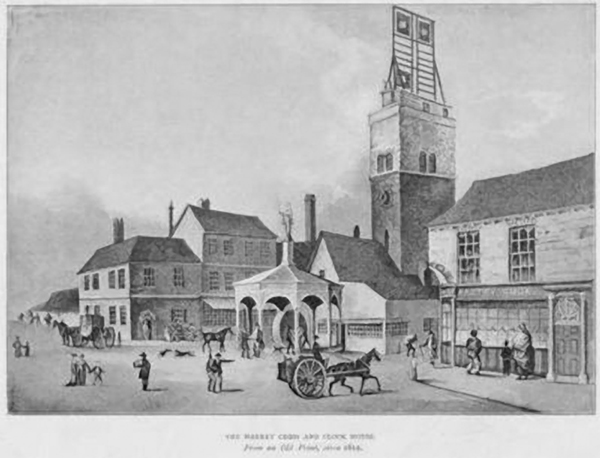
Sutherland’s view of the Clock Tower and Market Cross, housing a water pump, c.1812
Owing to the fear of a French invasion the Admiralty, in 1808, erected a semaphore signalling apparatus on the top of the Clock Tower, then called the Clock House. So effective was this telegraph that a message could be sent from London to Yarmouth and an answer received in the short space of five minutes. If this claim was well founded it seems strange that the apparatus was removed in 1814, the year before Waterloo brought our ancestors greater peace of mind.
In front of the Clock Tower was the Market Cross, with a figure of Justice on the top and a pump underneath, all of which was said to be ” very ornamental ” to that part of the town. The straw-plait market was held at the Market Cross until 1804, when it was removed to School Lane, now misnamed the Cloisters. In 1809 a waggon came into collision with one of the eight pillars of the Cross,[9] and caused so much damage that the structure had to be taken down.[10]
Near at hand was the shop of Mrs. Osborn, the chief pastry-cook in the town, whose window was filled each 6th of January with Twelfth-cakes, which on those faraway Epiphanies were eaten by everyone. Here, too, on the first day of each year, she and most other bakers in the town sold ” pop ladies,” curiously shaped buns crudely resembling a female figure with two currants for eyes. The name of ” pop lady ” is possibly a corruption of ” Pope Lady,” but, although several traditions exist, nothing is known as to how this old custom, which is peculiar to St. Albans, originated. It has been suggested that these buns had a religious significance, being intended to represent the Blessed Virgin, and that in the times of the Puritans they received the jeering name of Pope’s Ladies.”
The poor state of St Albans School
School Lane, to which I have referred above, led to a passage-way which ran through the Abbey, entirely separating the Lady Chapel and Antechapel from the main building. The Antechapel was then in a most dilapidated condition, partly from the weather being allowed to beat through the unglazed windows and partly from being used as a playground by the boys of St. Albans School, who for many generations had amused themselves by cutting the beautiful stonework with their pocket knives.

Passageway through the Abbey, looking towards Wax Gate
The Lady Chapel, or Virgin’s Chapel as it was then called, was used by the St. Albans School as their classroom. Here again the carving was sadly mutilated and covered with whitewash, the lower parts of the walls were panelled, the floor was boarded, and many of the windows filled in with slate.[11] The school was in a far from flourishing condition at the beginning of the nineteenth century, the number of scholars seldom exceeding seven or eight.
I will not attempt to give a description of the Abbey as it was a century ago, for this is a subject worthy of a separate article. Before retracing our steps along School Lane, however, we will notice the cedar tree in the Sumpter Yard. This was planted by the Dowager Countess Spencer on March 25th, 1803, and owes its curious umbrella-like shape to the fact that its top was broken off by boys when it was quite young.
The coaches shift to Verulam Road
The Verulam Road was made in 1825, before which date the main coach road to Dunstable and the northwest of England was down Fishpool Street, through St. Michael’s Village, across a portion of Gorhambury Park, and so out into the Redbourn Road at Bow Bridge, about one and a half miles from the town. Before the Red Lion, at the corner of Verulam Road, was rebuilt it possessed a curious feature, an underground stable to accommodate ten or twelve horses. This was at one time used for the horses that drew the stage waggons, and later for teams of coach horses.[12]
Verulam Arms
In 1827, two years after Verulam Road was made, the Verulam Arms was built, reputed to have been a very select hostelry where only those who could afford postchaises were catered for. Here Queen Victoria, then Princess Victoria, and her mother, the Duchess of Kent, stopped for lunch, when travelling by road from Scotland to London in 1835.
This inn was ruined by the advent of the railways and, shorn of its vast stables on the site of which Christ Church now stands, became in turn a private school, a straw hat factory, a private house and a Bishop’s Palace. It has recently started on a new, and it is to be hoped prosperous, chapter in its history as a Diocesan Church House.
Opposite Romeland House stood some cottages called the Blue Row,[13] so named because their wooden fronts were painted that colour. We are fortunate in still having ” Roome Land ” (the open or roomy land), as it was formerly called, for in 1817 the Corporation granted leave ” to bring the intended railway to Rome Land if necessary,” in 1827 it was nearly decided to build a new Town Hall on that spot, while at another time it was proposed to erect a row of red-brick villas extending from the corner of George Street to beyond the Old Gateway.
The town gaol

Abbey Gateway
That part of the old Monastery Gateway which is nearest to the Abbey was formerly the town gaol, while the other side was the place where vagrants were confined preparatory to their being whipped and sent back to where they came from. The daily ration of the unfortunate inmates of the St. Albans prison was 1 lb of bread, which was increased in 1812 to 1 1/2 lbs., and it was no uncommon experience, when passing the gateway, to see a white face at one of the grated windows and an old shoe lowered by a piece of string, while a piteous voice would plead for a trifle to be placed in it for buying food or firing. The law was very brutal in those days, and my grandfather saw men tied to the pillars of the Market House and flogged, and men tied behind a horse and cart and whipped round the town.
French prisoners of war
In 1810 there were 50,000 French prisoners in England,[14] some of whom were confined in the upper rooms of the Gateway. It is related that two Frenchmen attempted to escape through one of the upper windows and that one of them leapt into a tree and got away, while the other only succeeded in breaking his leg.
Fishpool Street, with its many turns and twists, must have been a difficult thoroughfare for coaches when it was the highway to the north-west, but it remains as picturesque as when Sheppard painted it in 1809, and is practically the same to-day as it was 120 years ago.
The sporting vicar of St Michaels
St. Michael’s Church in the early part of the nineteenth century had a typical sporting vicar, the Rev. Lord Frederick Beauclerk, who was a well-known cricketer at Lord’s, a good hunter and steeplechaser. In 1834 he won the St. Albans Grand Steeplechase on one of his horses named The Poet. To avoid objections by his Bishop he rode under the name of Mr. Brand. The church, before the restoration of 1867, had high pews, some of which were furnished with small stoves with chimneys.
The late Mr. H. J. Toulmin, one of the oldtime churchwardens, used to tell of a worshipper who was accustomed to take with him to church a cold meat pie. This he placed upon the stove during the service, after which he partook of it hot for his mid-day meal, and then slept in his pew until the next service began.
And here our ramble must end. Although some of my readers may be more interested in years of very long ago, I hope that others will find pleasure in hearing about the comparatively modern times of our dear old town.
___________________________________________________________________________________
Footnotes
[1] The line from Watford was opened on May 5th, 1858, which was made a public holiday, that from Hatfield on October 16th, 1865, and the Midland main line station on October 1st, 1868.
[2] The new London road was made in 1794, but building operations were not started until a good many years later; in fact my grandfather remembered the time when there were only some half-dozen houses between the Peahen and London Colney.
[3] At Bartholomew Fair Richardson charged sixpence for admission, while all but two others charged a penny. In 1828 his takings there were £1,200. In the same year the Pig-faced Lady, at a penny admission, netted £150. Wombwell’ s Menagerie, at sixpence, came out best with receipts of £1,700.
[4] In Buckler’s picture of 1835 is shown one of the old lamp brackets, and beside it a standard for gas, then just installed.
[5] My grandfather remembered seeing these gates illuminated in celebration of the victory of Waterloo.
[6] The fare to London by the long-distance coaches was 5/-, while the guard expected a shilling for himself and saw that he got it.
[7] The change of name was made in 1876.
[8] In 1856 the Treasury consented to the pulling down of the Market House and the sale of the materials. The Corn Exchange was opened on September 23rd, 1857.
[9] The Cross had previously, in 1777, been damaged in a similar way. On that occasion tho owner of the waggon was called upon ” to make satisfaction ” for the cost of repair, amounting to £5 Is. 6d.
[10] The statue of Justice was removed to the roof of the Market House, but the pump remained with a light iron railing round it.
[11]The school remained in the Lady Chapel until 1870, and the public pathway was closed in 1874.
[12] The site of this stable is now covered by the hotel garage.
[13] These and neighbouring cottages were demolished in 1823 by order of the Corporation.
[14] Nearly 12,000 of our men were in French prisons, and neither side can claim to have given decent treatment to its involuntary guests.